
Your Back Is Stronger Than You Think
What the research actually says about back pain, MRIs, and why fear hurts more than the herniation
A quick note before we start: This article is educational. It's not medical advice, it's not a diagnosis, and it's not a substitute for working with a qualified healthcare provider. If you're dealing with back pain, especially the kind that's severe, getting worse, or accompanied by any of the warning signs we'll cover below, see a clinician. What we're doing here is helping you understand the research so you can stop being afraid of your own back.
The First Instinct Is Usually Wrong
Low back pain is one of the most common reasons people end up in a doctor's office. And for a lot of folks, the first thing they want is a picture — get an MRI, find out "what's really going on" down there, and finally have an answer.
It makes sense on the surface. Something hurts. Look at it.
But here's the thing: for most people with back pain, an early MRI doesn't help. It often makes things worse. And understanding why is one of the most important pieces of education we can pass along to anyone who walks into a gym worried that their body is broken.
What the Research Actually Shows
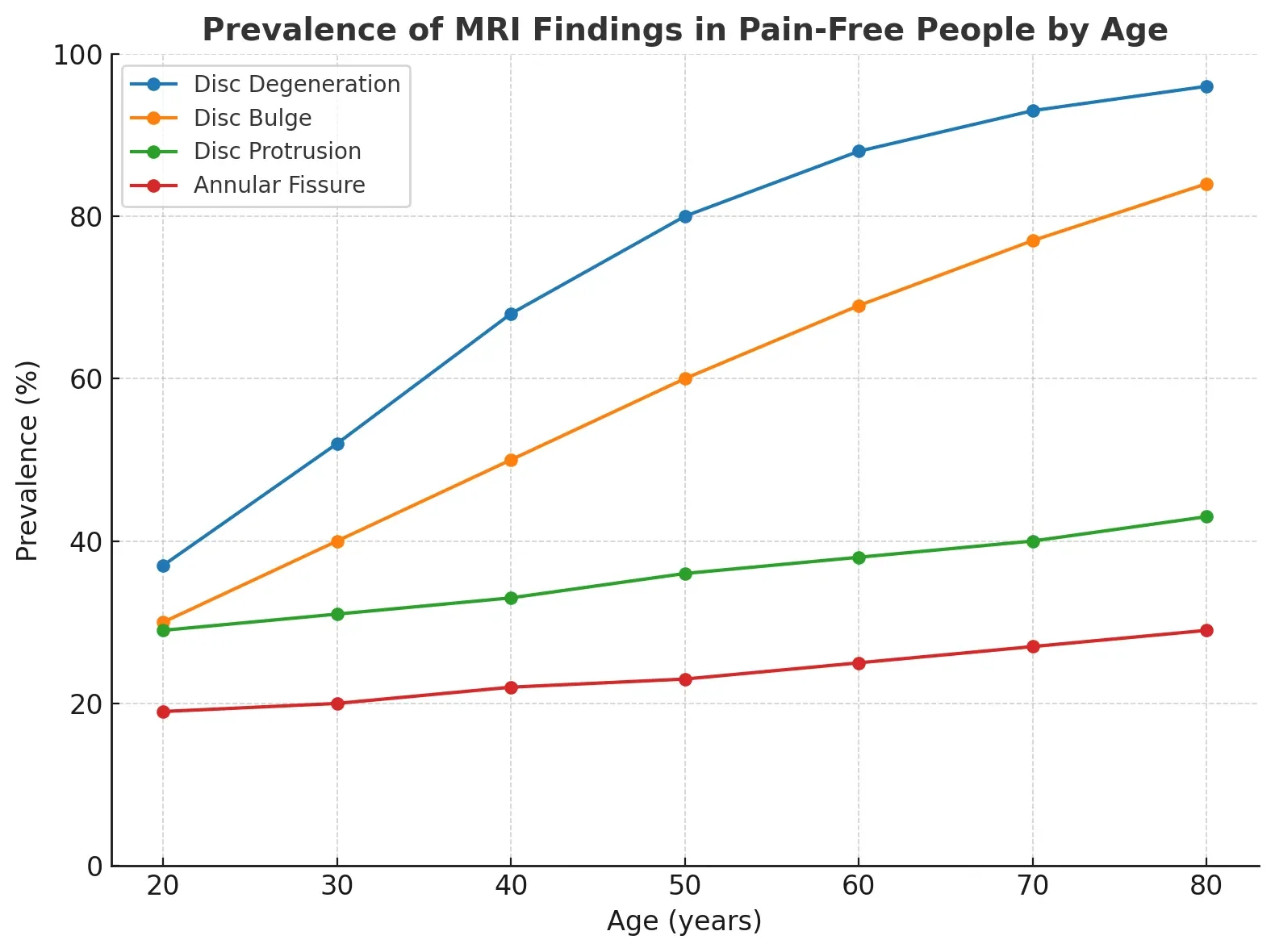
A large systematic review published in the American Journal of Neuroradiology scanned more than 3,100 people who had no back pain at all, just to see what their spines looked like.
The findings should be required reading:
Disc degeneration: Found in 37% of HEALTHY 20-year-olds and 96% of HEALTHY 80-year-olds.
Disc bulges: Present in 30% of PAIN-FREE 20-year-olds and 84% of those over 80.
Disc protrusions (commonly called "herniations"): 29% at age 20, climbing to 43% at age 80.
Annular fissures (small disc tears): About 1 in 5 young adults and nearly 1 in 3 older adults.
Read that again. These are people WITHOUT PAIN.
By your 40s, the majority of humans walking around feeling fine have “abnormal" findings on their spine. By your 60s, almost everyone does. Disc changes are often just part of the body's natural remodeling — like gray hair, wrinkles, or calluses. Internal evidence of a life that's been lived.
An MRI shows you a snapshot of structure. It does not, on its own, tell you WHY something hurts.
The Fear Factor: When Words on a Report Become the Problem
This is where it gets important.
Pain isn't a pure readout of tissue damage. Pain is an alarm system, and that alarm is shaped by what your brain believes about the threat. When someone reads words like degeneration, bulge, herniation, tear on a report, their brain flags the back as fragile. As damaged. As something to protect.
That belief changes behavior. People start moving less. They guard. They stop bending, lifting, training. They tighten up around the area they've been told is “wrong." And all of that — the guarding, the avoidance, the deconditioning — feeds the pain cycle.
The research backs this up. Studies consistently show that people who get early imaging for uncomplicated back pain:
Report higher anxiety
Recover more slowly
Use more medication
Are more likely to end up with injections or surgery — even when those interventions weren't necessary
The scan didn't cause the problem. The story we built around the scan did.
When Imaging Actually Matters
We're not anti-MRI. There are situations where imaging is absolutely the right call, and these need to be taken seriously. If you're experiencing any of the following, you need to see a qualified medical provider — not a gym, not a YouTube video, a clinician:
Sudden loss of bowel or bladder control
Severe or progressive weakness in the legs
Significant trauma (a fall, an accident)
A history of cancer with new back pain
Signs of infection — fever, chills, unexplained weight loss alongside back pain
These are the “red flags." Outside of these, the American College of Physicians and most major spine guidelines recommend waiting at least six weeks before imaging — and only then if symptoms aren't improving.
So What's Actually Driving the Pain?
For the vast majority of people, back pain doesn't trace back to one dramatic structural villain. It's usually a mix of factors stacked on top of each other.
Irritated, not destroyed. Discs, joints, ligaments, and muscles all have nerve endings. When they're overloaded or sensitized, they signal. That signal can be loud even when imaging looks unremarkable — and imaging can look “ugly" in people with zero pain.
Chemistry, not just mechanics. When a disc herniates, it can trigger an inflammatory response around nearby nerves. That chemistry can drive sciatica-type pain even when the mechanical compression isn't dramatic. The size of the herniation doesn't always match the level of pain because the inflammation around it matters too.
A sensitive alarm system. High stress, poor sleep, anxiety, and widespread sensitivity can crank up the volume on pain signals, regardless of what a scan shows. The system gets louder than the actual fire.
Lifestyle load. Sleep debt, chronic stress, low activity, deconditioning, and abrupt changes in workload all push the system toward sensitivity. These factors usually matter more than finding the “perfect picture" on an MRI.
Serious causes are rare — but they exist, which is why we screen for them with the red flags above.
Discs Are More Resilient Than You've Been Told
One of the biggest myths floating around: “Once a disc is herniated, it's permanently damaged."
It's not true.
A meta-analysis looking at dozens of studies on lumbar disc herniations found:
Many herniations shrink or completely resolve within a year — without surgery.
Larger herniations sometimes resorb faster, because the immune system actively breaks down and reabsorbs the displaced material.
People often feel better long before their MRI looks “better." Symptoms improve ahead of the picture.
Your body is not a broken machine. It's a living, adaptive system built to repair, remodel, and recover.
Why a Strong Body Matters
Here's where we come in — not as people who treat back pain, but as people who help build the kind of body that's resilient against it.
A spine that's used to being loaded is a spine that handles load. A body that moves through full ranges of motion under control is a body that doesn't panic when life asks it to bend, lift, or twist. A nervous system that's been exposed to challenge in a smart, progressive way is a nervous system that's harder to spook.
That's what training does. Not as a cure. As an investment.
When people get strong — when they build real, earned capability — a lot of things change. Their tissues tolerate more load. Their movement patterns get more confident. The fear of “tweaking" something quietly fades, because they've spent months proving to themselves that their body works. They sleep better. They handle stress better. They feel less fragile.
You don't need a perfect spine on an MRI to live a strong life. Most people don't have one anyway.
Principles for a Resilient Back
A few common-sense ideas that the evidence consistently supports:
Keep moving. Even gentle movement beats stillness when something flares up. Bed rest is not the answer.
Manage load intelligently. Don't abandon lifting forever — but be smart about progression. Earn the load.
Train your whole body. A strong back lives inside a strong system. Hips, core, glutes, lats, grip — it all matters.
Don't fear the basics. Hinging, squatting, carrying, and pulling are not what's hurting you. Being unprepared for them might be.
Take care of the foundation. Sleep, stress, hydration, and nutrition all affect how sensitive your system is.
Get qualified help when you need it. A flare-up that isn't improving deserves a proper evaluation by a clinician.
The Bottom Line
Your spine is built to move, bend, lift, and adapt. Pain does not automatically mean damage. Findings on a scan don't define what your body is capable of. And even when there's a real structural issue, your body has remarkable capacity to heal, adapt, and come back stronger.
The goal isn't to avoid your back. The goal is to build the kind of body — and the kind of mindset — that doesn't live in fear of it.
That's what we're in the business of.
This article is for educational purposes only. It is not medical advice and does not replace the judgment of a licensed healthcare provider. If you're experiencing back pain — especially anything involving the warning signs listed above — please consult a qualified clinician. Six20 Strength is a personal training facility; we build strong bodies, we don't diagnose or treat medical conditions.

References
Brinjikji W, Luetmer PH, Comstock B, et al. Systematic Literature Review of Imaging Features of Spinal Degeneration in Asymptomatic Populations. AJNR Am J Neuroradiol. 2015;36(4):811–816. doi:10.3174/ajnr.A4173
Zhong M, Liu JT, Jiang H, et al. Incidence of Spontaneous Resorption of Lumbar Disc Herniation: A Meta-Analysis. Pain Physician. 2017;20(1):E45-E52.
